History of the protocol
Five years, two names, one missed deadline. Everything below can be checked against the sources listed at the end.
2021 — a different name
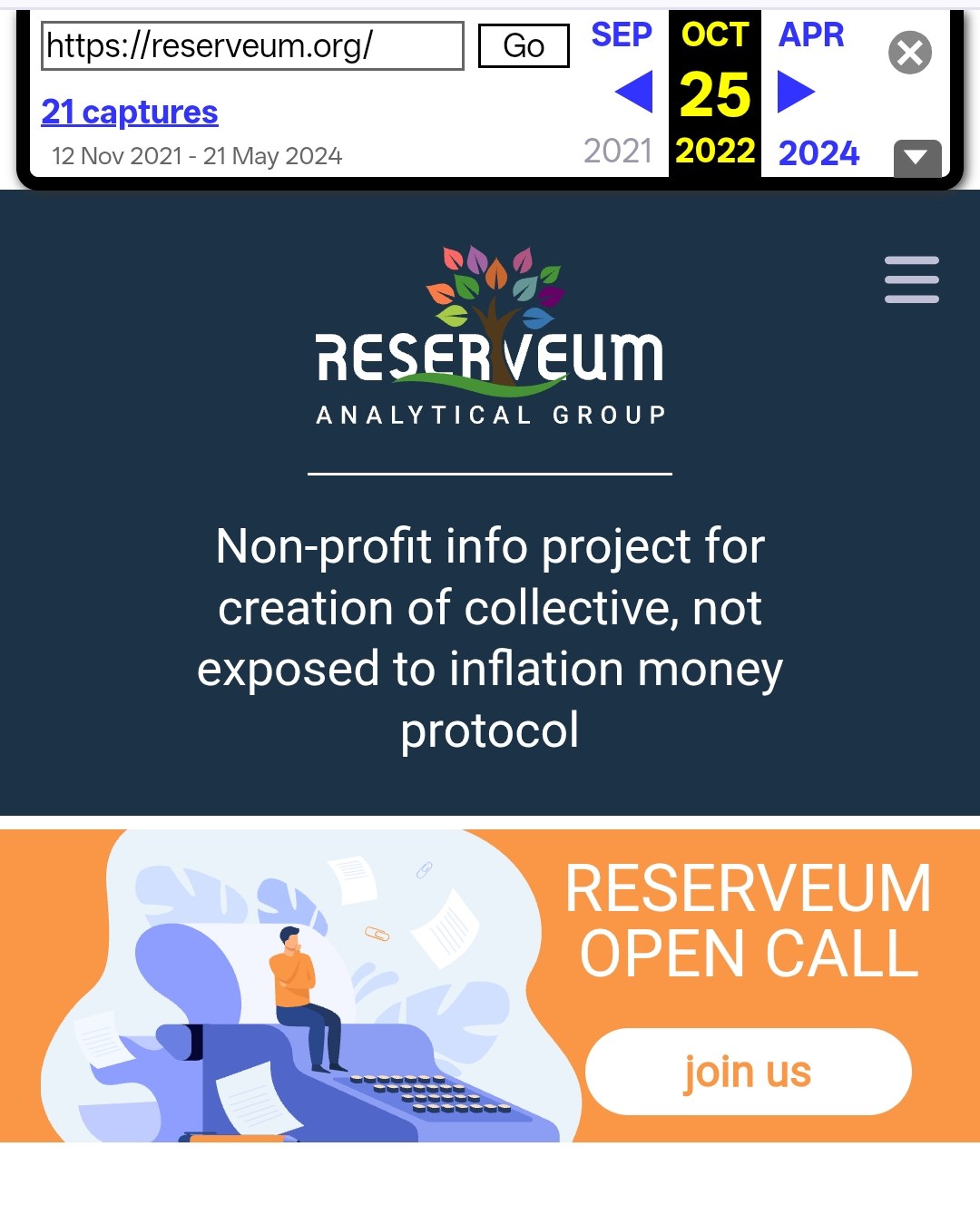
The work began in 2021 under the name Reserveum. An analytical group published research on inflation and the failures of fiat money, and set out to build a protocol for holding digital value that inflation could not erode. Its working title was the RNC&I Protocol — Reserveum non-Custodial & Inflation.
The first public notice appeared in November 2021. The group's site and blog ran continuously from then until 2024.
2022 — the first model
RSM
By May 2022 the group had a design, and only a design: mathematics, a specification and research on paper. Nothing was deployed and no contract was running. No coin has ever been minted on a live network — the only minting happened on test networks.
What the model described: new coins minted against collateral the community had approved; any holder able to burn a coin and take the collateral back at any moment; and each new coin costing more than the last, along a hyperbolic curve in the first stage.
The design also split coins into two states. Newly minted coins that had never moved were called Cherry; once a coin was transferred it became Regular. That distinction is still here, under different names: the position and the token.
2024 — the rights change hands
Reserveum → Assetrix
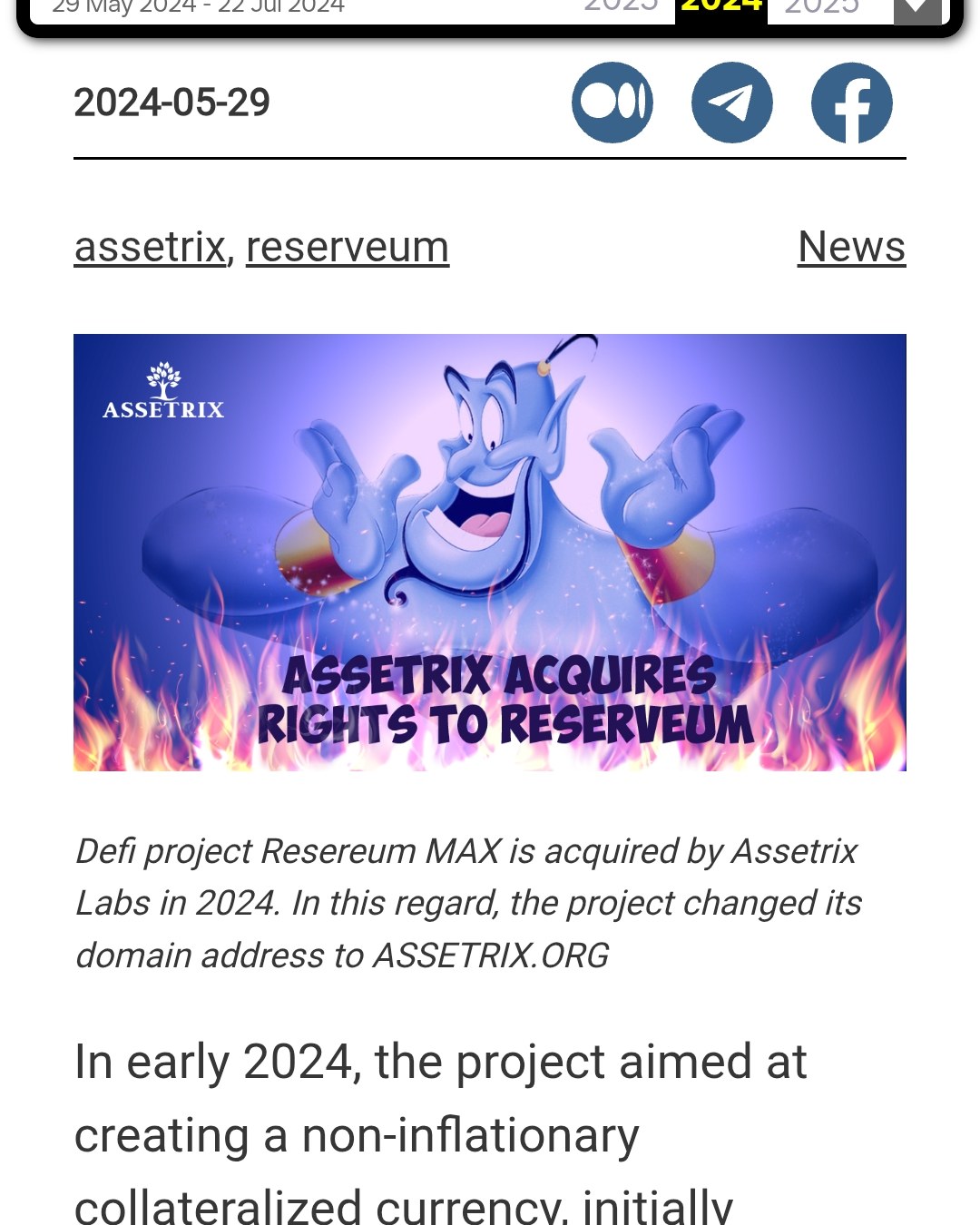
In early 2024 the project was acquired by Assetrix Labs. The coin was renamed from RSM to ASX and the domain moved from reserveum.org to assetrix.org. The change was announced on 29 May 2024.
The handover is visible in the public record, not only in our own announcement. On 18 May 2024 the Internet Archive captured assetrix.org still serving the Reserveum site. By 22 July the same address served Assetrix.
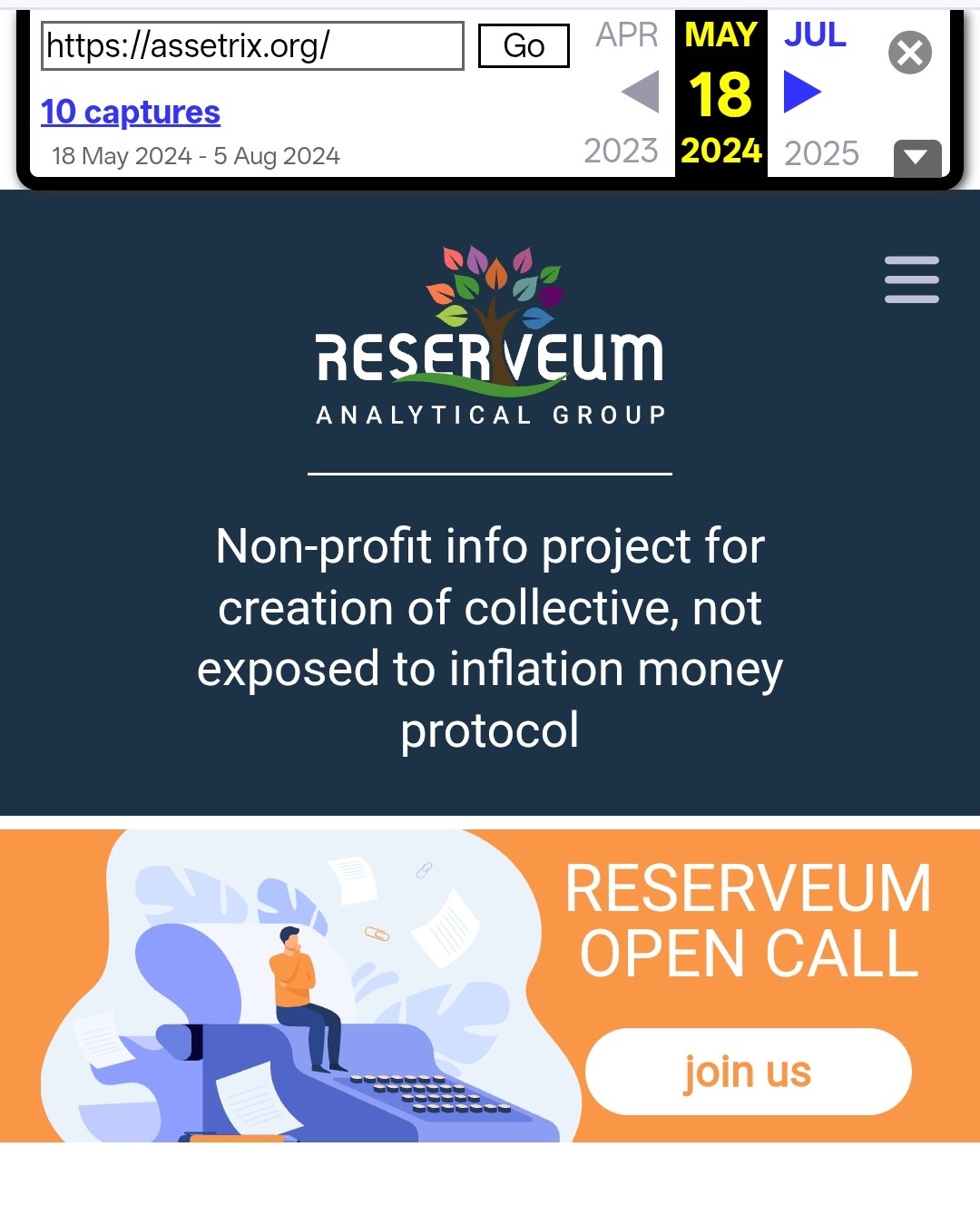
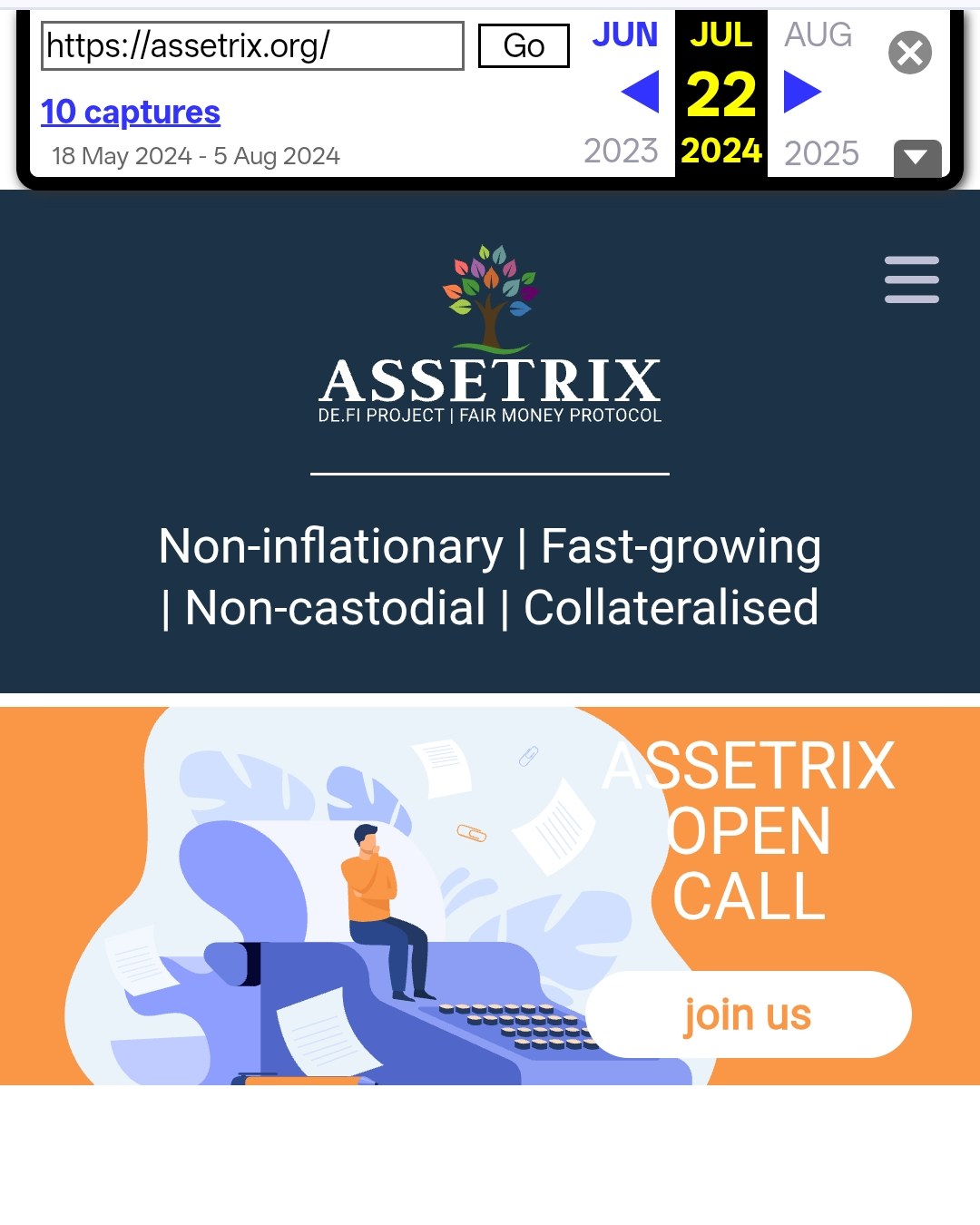
These are archived copies of the site as it stood in 2024, before the contract was written. Wording visible in them — “Fast-growing” — is excluded from the site today: it contradicts this project’s policy outright.
2025 — a date we named and missed
The 2024 announcement said the launch was scheduled for August 2025. It did not happen. The date passed with nothing shipped.
The reason was research, not construction. By 2024 the blog had gathered a sizeable readership, and readers wrote in. Many of them proposed designs of their own for a token that rises — several genuinely original. The team modelled those designs and tested them, looking for the best one.
What came out of that work was a negative result. A token that rises and never retraces cannot be built. Not with a fixed supply, and not with a supply that breathes — holders arriving and leaving, money flowing in and out, the whole system oscillating like a spring. Corrections are unavoidable. A design that claims otherwise is either hiding the correction somewhere else or has not looked hard enough.
That result cost a year, and it changed what was being built. Corrections cannot be removed, but they can be bounded and a direction can be set. What exists now is that compromise: a ceiling that only rises, and a floor that cannot fall below a level the holders themselves set. Between the two, the market does what markets do.
2026 — what was rebuilt
The pause was not idle. The model was taken apart and put back together. What follows is not a list of improvements; it is a list of things that were wrong or unsafe in the earlier design.
Names that hid the mechanism
Cherry and Regular became the position and the token. A position is now an NFT: it records the cost of entry, and closing it returns the collateral in full. The old pair sorted coins by whether they had ever been transferred — fragile, and opaque from the outside.
A name for the asset class that promised something
The class was going to be called an upcoin. Two problems: an active fraudulent exchange already trades under that name, and the word itself implies a promise of growth. It was dropped. The class is called a ratchet.
Numbers that did not match the formula
- Capital at the end of stage 1 was stated as $55.8k; the formula gives $20.1k.
- Capital accumulated by stage 3 was stated as $923k; it is $887k.
- The first rung of the growth ladder was 3.4%; it is 5.6%. A 50% rung was added.
Collateral that could not be priced
PYUSD and USDS were listed as accepted collateral. Neither has a price feed on Arbitrum, and a currency that cannot be priced cannot be accepted. Both were moved to candidate status, admission subject to a holder vote.
Two construction errors found by a reference model
The protocol was reimplemented in Python, independently of the text, and the two implementations were compared. The comparison found errors invisible in prose:
- The headroom formula in backing protection used undamped values while backing itself used the damper. On a small pool the protection threshold could be breached.
- The mint price was undefined for operations covering many tokens. Read literally, $200,000 would have claimed the whole of Phase 1 at a price of $0.001.
Five claims about optimisation that were not true
Both white papers described storage-slot packing and permit signatures as implemented. They were not. The claims were removed and the section rewritten to describe what the code actually does.
How it is checked
617 local tests and 44 tests against a fork of live Arbitrum One. A reference implementation in Python, written from the specification rather than from the contract, so that the two can disagree: 33 checks compare them. Mutation testing: deliberate defects are injected into the compiled bytecode, and a test suite that still passes is a test suite that is not looking.
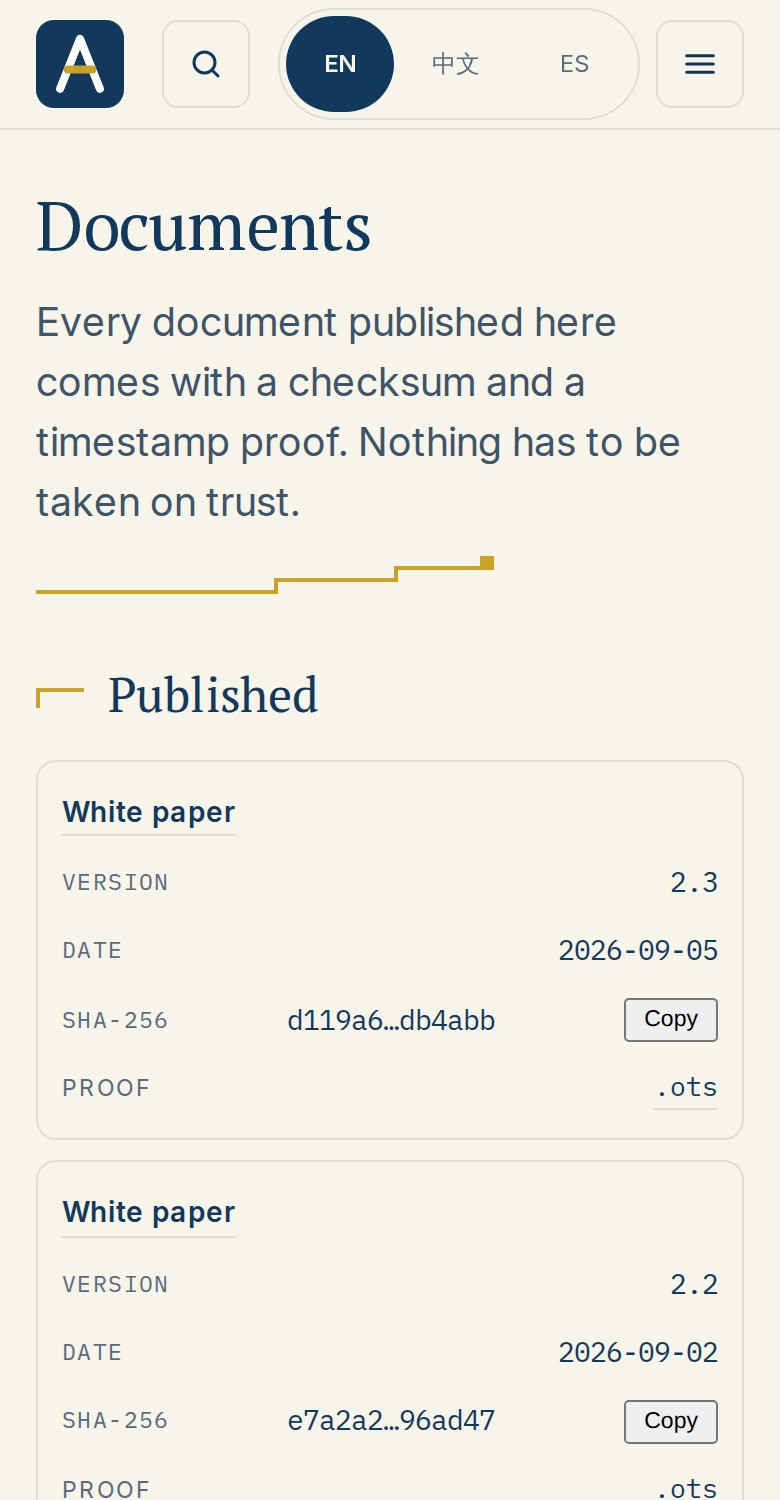
Every published document carries a SHA-256 checksum and an OpenTimestamps proof anchored in the Bitcoin blockchain. Those are on the documents page, and they can be verified without asking us.
Where it stands
The contract is written and tested, and it runs on a test network. On the main network there is no token to buy, no sale, and no date announced — the last date we announced was missed, and we will not name another one until the work behind it is finished.
Sources
| Date | What | Whose |
|---|---|---|
| Nov 2021 | First public notice of the RNC&I ProtocolA paid placement, and it uses wording this project no longer uses. | ours, paid placement |
| 2021–2024 | 21 Internet Archive captures of reserveum.org | independent |
| Apr 2022 | Model details presented at Bitcoin 2022, Miami | third-party coverage |
| May–Jun 2022 | Coverage of the RSM design: Cherry and Regular, hyperbolic first stageOne release sent to several outlets, so the wording repeats. It describes an earlier design and makes claims about income that this project does not make. One of the pages is still reachable; the rest are gone. | third-party, single syndicated release |
| 2021–2022 | Research blog, including an outside contributorPublished under the earlier name. Older posts use wording this project no longer uses. | ours |
| 18 May 2024 | assetrix.org captured still serving the Reserveum site | independent |
| 29 May 2024 | Announcement of the rights transfer | ours |
| 2 Jun 2024 | The same announcement on the project blogIt says reserveum.org leads to assetrix.org. That is out of date: the domain lapsed, it is not ours, and there is no redirect. | ours, published under the Reserveum account |
| 22 Jul 2024 | assetrix.org captured serving Assetrix | independent |
Earlier public statements used language this project no longer uses — “fast-growing”, “passive income”, a community size we cannot verify. Those statements are part of the record and are not repeated here.